-KH News Desk (editorial1@imaws.org)

In an Indian startup landscape often defined by billion-dollar valuations, aggressive capital burn, and a “metro-first” expansion bias, a quieter but more resilient movement is emerging from the nation’s Tier-2 cities. DropiFly Technologies Private Limited, founded by entrepreneur Rashmi Kamaraj, has officially launched its operations in Dindigul, Tamil Nadu. While the launch marks a new entry into the food delivery and logistics space, DropiFly is distancing itself from the “burn-to-earn” models of its predecessors. Instead, it is positioning itself as a hyperlocal infrastructure platform built for sustainability, vendor empowerment, and long-term ecosystem balance.
Addressing the Structural Gaps in India’s Delivery Ecosystem
Over the last decade, India’s hyperlocal sector has expanded at breakneck speed, fueled by massive venture capital and AI-powered logistics. However, this rapid scaling has often come at a cost. The industry has frequently struggled with:
- Margin Compression: Small vendors often see their profits evaporated by high commission structures.
- Gig-Worker Volatility: Delivery partners face unpredictable incentives and high churn.
- Economic Misalignment: Business models designed for high-density metros like Bengaluru or Mumbai often fail to align with the local economics of smaller cities.
DropiFly enters this space not to disrupt for disruption’s sake, but to bridge these gaps. Born in Dindigul, the platform is intimately aware of the nuances of Tier-2 markets: lower average order values, tighter vendor margins, and a heavy reliance on community trust and daily cash flow cycles.
A New Face of Leadership in Logistics
The hyperlocal industry is notoriously operationally intensive, requiring real-time coordination, financial risk management, and complex regulatory alignment. Building this infrastructure from a Tier-2 city, away from the traditional metropolitan investor corridors, presents a significant challenge.
As a woman founder leading a logistics-heavy business, Rashmi Kamaraj represents a meaningful shift in India’s entrepreneurial demographic. Her leadership signals that disciplined innovation is no longer geographically confined to “Silicon Plateau.”
“Tier-2 India doesn’t reward noise,” says Kamaraj. “It rewards consistency, trust, and financial discipline. We aren’t chasing vanity metrics; we are building a foundation that stays firm even when the capital markets are volatile.”
The Four Pillars of the DropiFly Philosophy
To ensure longevity, DropiFly has anchored its operations on four non-negotiable pillars:
- Vendor Strength: Treating local restaurants and retailers as economic pillars rather than just supply nodes.
- Stable Employment: Viewing riders as vital stakeholders who deserve predictable income and respect.
- Customer Transparency: Building trust through clear, structured pricing rather than fluctuating “surge” models.
- Structural Survival: Prioritizing positive unit economics from day one to ensure the platform remains durable.
Strategic Roadmap: Depth Before Width
Rather than a blanket launch across the state, DropiFly is following a disciplined, phased expansion roadmap. This “city-first” strategy focuses on operational depth before pursuing geographic width.
- Phase 1: Dindigul (Current): Focus on stabilizing the vendor ecosystem and optimizing delivery routes.
- Phase 2: Madurai: A structured entry leveraging local partnerships and vendor-first positioning.
- Phase 3: Trichy: Scaling based on density and learnings integrated from previous deployments.
This approach reduces financial exposure and ensures that each city is self-sustaining before the company moves to the next.
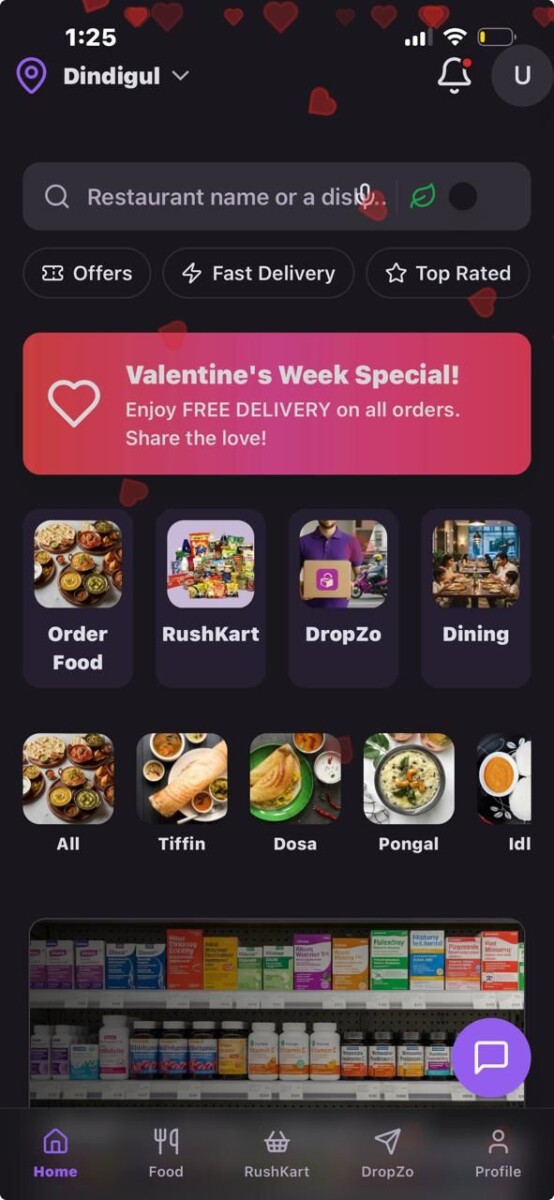
Beyond the App: Building Hyperlocal Infrastructure
DropiFly views its technology not just as an app, but as a digital infrastructure layer. The goal is to connect restaurants, grocery stores, small merchants, and a student workforce into a cohesive network. By providing digital access without eroding vendor control, the platform reinforces local markets rather than replacing them.
A key component of this is youth activation. By formalizing part-time logistics roles for students and the local workforce, DropiFly creates predictable income opportunities in regions where such roles are often disorganized.
Why Tier-2 is the Next Growth Frontier
As smartphone penetration reaches saturation in metros, the next wave of digital adoption is coming from Tier-2 and Tier-3 cities. These regions offer:
- Stronger small-business networks.
- Increasingly tech-savvy consumer bases.
- Underserved demand for reliable, professional logistics.
By prioritizing financial discipline—controlled customer acquisition spend and sustainable operational radii—DropiFly is positioning itself as a leader in this structural transformation.
Looking Ahead
The official launch in January 2026 in Dindigul is just the beginning. DropiFly envisions a future where Tier-2 commerce ecosystems are digitally empowered but remains rooted in local autonomy. As the company prepares for its Madurai and Trichy expansions, it welcomes vendor partnerships and strategic collaborations from those who believe in a more balanced, sustainable version of the Indian digital economy.