-KH News Desk (editorial1@imaws.org)
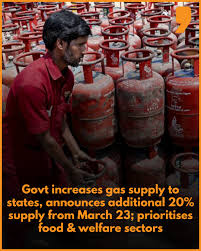
In a major policy shift aimed at stabilizing energy costs, the Government of India has announced a significant increase in the allocation of domestic natural gas. Effective from March 23, 2026, the supply of gas to various sectors will be raised to 50% of pre-crisis levels, following an additional 20% supply infusion directed primarily at the domestic and transport sectors.
The decision comes as part of a broader strategy to mitigate the impact of fluctuating global energy prices on Indian consumers. By prioritizing the City Gas Distribution (CGD) networks, the Centre intends to bring down the input costs for Compressed Natural Gas (CNG) used in vehicles and Piped Natural Gas (PNG) used in kitchens across the country.
Key Impacts of the Gas Allocation Increase:
-
CNG and PNG Relief: The move is expected to lead to a reduction in retail prices for CNG and PNG, providing direct financial relief to millions of commuters and households.
-
Industrial Support: Increased allocation will help small and medium enterprises (SMEs) that rely on natural gas for their manufacturing processes, potentially lowering production costs and boosting competitiveness.
-
Power Sector Efficiency: The additional supply will support gas-based power plants, which often struggle with high operational costs due to expensive imported Liquefied Natural Gas (LNG).
-
Energy Security: By utilizing a higher proportion of domestic gas, the government aims to reduce the country’s dependency on costly energy imports and strengthen national energy security.
Official Perspective: A spokesperson from the Ministry of Petroleum and Natural Gas remarked: “Our priority is to ensure that the benefits of domestic energy resources reach the common man. Increasing gas allocation to 50% of pre-crisis levels is a bold step towards ensuring affordable and clean fuel for all sectors of our economy. This additional 20% supply starting March 23 is a clear signal of our commitment to energy stability.”
Economists suggest that this move could also have a cooling effect on inflation, as transport costs—a major driver of food and commodity prices—are expected to stabilize with cheaper CNG availability.